Emergency Funds Are Overrated: Why Loans Might Be Better in a Crisis?
September 18, 2025
Key Takeaways
- Emergency funds offer immediate access without interest costs but may underperform due to low yields and inflation risk in Singapore.
- Loans can provide faster liquidity for large or infrequent emergencies, especially when paired with stable income and strong credit.
- In Singapore, emergencies often involve medical bills beyond insurance, urgent repairs, or job loss, situations where loans may be practical alternatives.
- Emergency funds vs loans is not an either-or decision; maintaining a small emergency fund while using loans strategically can optimise both flexibility and growth.
- Licensed moneylenders are a regulated option for borrowers who may not qualify for bank loans, with strict interest and fee caps under Singapore law.
- Borrowers should always check the effective interest rate (EIR) and avoid exceeding MAS’s borrowing limits to ensure safe and affordable loan use.
- Cash savings are more suitable for those with variable income, poor credit, or frequent minor emergencies, where loan access may be limited or impractical.
Most people are told to save a large emergency fund before thinking about anything else. The usual advice is three to six months of living expenses in cash. But in a city where living costs are high, CPF is locked away until later in life, and insurance already covers many risks, is it really necessary to keep such a large pile of cash on standby?
The truth is, holding too much in an emergency fund can sometimes slow down your financial growth. In certain cases, loans can be a smarter, cheaper, and more flexible way to handle sudden costs. This article explores emergency funds vs loans, showing when each makes sense and how to balance the two in Singapore.
Table of Contents
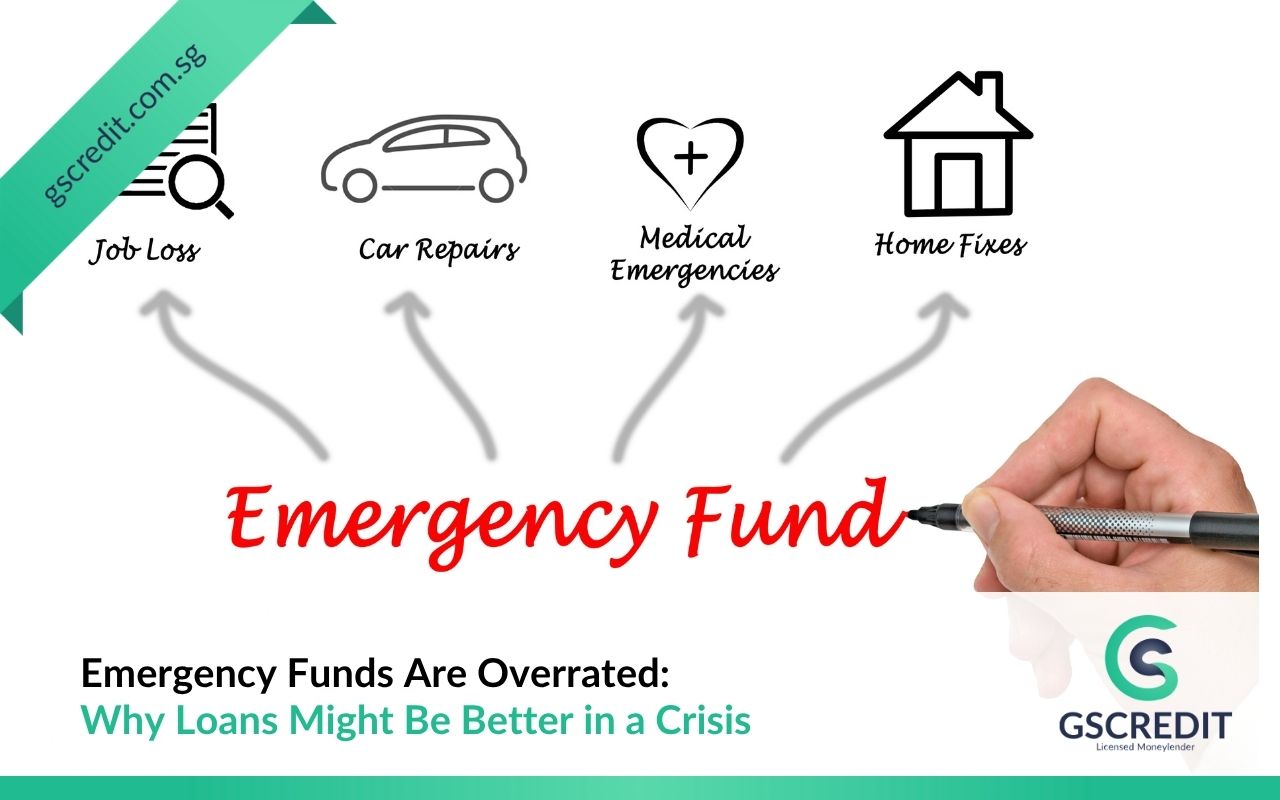
What Counts As An Emergency In Singapore?
Not every unexpected bill is a true emergency. In Singapore, emergencies often involve situations where the cost is big, sudden, and unavoidable.
Medical Bills Beyond Insurance
MediShield Life and Integrated Shield Plans cover a good portion of medical costs, but not everything. If you choose a private hospital or a non-subsidised ward, you may need to pay a significant amount from your own pocket.
Sudden Job Loss
Losing your job is another common emergency. It can take months to secure a new role, and you still need to cover rent, bills, and daily expenses during that time.
Urgent Home Repairs
Problems like burst pipes, faulty wiring, or major appliance breakdowns can’t wait. These repairs often cost thousands and must be fixed quickly for safety and comfort.
Car Breakdowns
If you rely on a car for work or family needs, a sudden breakdown can disrupt daily life. Repairs or replacements of major parts can be very expensive.
Family Obligations
Emergencies don’t always happen to you directly. Many people step in to support parents, children, or siblings when they face sudden expenses, making family obligations another form of emergency.
Emergency Funds: Pros, Cons And Realities
An emergency fund is money set aside for unexpected costs. It provides peace of mind, but it also comes with downsides.
Looking for Reliable Financial Solutions?
Fill in the form and our team will respond as soon as possible.
Benefits Of An Emergency Fund
The main benefit of an emergency fund is instant access. Cash is always available, and there is no need to apply for approval or pay interest. It also reduces stress, as many people feel safer when they know they have a buffer.
Drawbacks Of An Emergency Fund
Money in savings accounts or fixed deposits grows very slowly, often at rates lower than inflation. This means your money loses value over time. Large balances can also tempt people to spend unnecessarily, and there is an opportunity cost since that money could be invested for better returns.
Where To Keep Emergency Funds
Where you keep your emergency fund also matters. High-yield savings accounts are convenient, but interest rates change. Fixed deposits give higher returns, but there are penalties for early withdrawal. T-bills offer good yields, but they are less liquid, which makes them less suitable for urgent expenses.
CPF, while important, should not be counted as an emergency fund. It cannot be withdrawn freely and is meant for retirement, housing, and healthcare.
Loans For Emergencies In Singapore

Loans provide another way to handle emergencies when savings are not enough. In Singapore, you have three main choices:
Bank Personal Loans And Credit Lines
These are popular with salaried workers who have stable income and good credit. Banks often approve them quickly, but the interest rates vary. Always check the effective interest rate (EIR) rather than just the advertised rate. MAS also monitors unsecured borrowing closely to prevent people from taking on too much debt.
Credit Card Instalments And Balance Transfers
These are useful for short-term borrowing. Many come with low or even zero interest during a promotional period. However, once the promo ends, interest rates increase sharply, so it is important to repay on time.
Licensed Moneylenders
This option is for people who cannot qualify for bank loans. Licensed moneylenders are regulated by the Ministry of Law. Interest is capped at 4% per month, and fees such as late charges are controlled. Even so, these loans are more expensive than bank loans, so they should be used carefully.
Consider GS Credit For Personal Loans
Emergencies don’t wait for savings to grow. That’s why GS Credit offers personal loans with clear terms and fast approval. As a licensed moneylender, GS Credit provides repayment plans that suit your needs so you can focus on solving the emergency, not worrying about paperwork. Apply for a personal loan with us today.
What The Rules Mean For You
Singapore has clear rules to make borrowing safe:
MAS Unsecured Borrowing Cap
You can borrow up to 12 times your monthly income. If you exceed this cap for three months, you may not be able to take new loans.
Licensed Moneylender Rules
The Ministry of Law enforces strict rules. Interest is capped at 4% per month, late fees are capped at $60 per month, and the total cost cannot exceed the principal borrowed.
Credit Records
Your credit history matters. Banks check your repayment record through Credit Bureau Singapore (CBS). A poor record can result in higher rates or rejection of loan applications.
Emergency Funds Vs Loans: Quick Comparison
| Factor | Emergency Fund | Loan |
|---|---|---|
| Access | Instant cash | Fast if pre-approved, else some checks |
| Cost | No interest, only inflation risk | Interest and fees, can be low if repaid fast |
| Cash Flow | Money goes out upfront | Payments spread over time |
| Behaviour Fit | Best for those who dislike debt | Best for disciplined borrowers |
When Loans Can Be Better?

Loans can sometimes work better than relying on a very large emergency fund. This usually applies to people who have strong credit records, steady jobs, and confidence that they can repay within a short time, such as three to twelve months. In such cases, the cost of borrowing can be lower than the long-term cost of keeping cash idle in low-interest accounts.
Keeping Money Invested Or Reserved
Loans also allow you to keep money invested or reserved for other financial goals. For example, if your funds are already set aside for a home down payment or investments that earn more than the cost of a loan, it may make sense to borrow for emergencies instead of pulling money out of those goals.
Insurance Coverage As A Buffer
If you already have MediShield Life and an Integrated Shield Plan, large unpredictable medical bills are less likely. Any remaining expenses may be smaller and time-limited, making short-term borrowing a practical solution.
Backup For A Small Emergency Fund
Loans can also be a good backup if you already keep a small emergency fund but prefer not to hold more cash. This allows you to stay liquid without tying up too much in low-yield savings.
When To Stick With An Emergency Fund?
In some cases, it is still safer to rely on an emergency fund.
Variable Income
People with unstable income, such as freelancers or gig workers, may find loans risky because their earnings are not predictable. Having cash on hand avoids repayment pressure when income is uncertain.
Near Borrowing Limits
If you are already near the MAS borrowing cap, you may not qualify for new loans when you need them most.
Weak Credit History
If your credit record is weak, loans may be costly or unavailable. In such cases, savings become the safer choice.
Frequent Smaller Emergencies
Emergency funds also work better for households that face regular smaller expenses, like medical visits or minor home repairs. Using cash is simpler and quicker than arranging credit each time.
Smart Borrowing Tips
If you plan to use loans for emergencies, make sure you borrow wisely.
- Check The Effective Interest Rate: Always check the effective interest rate (EIR), not just the flat rate, as EIR reflects the true cost.
- Stay Within MAS Limits: Do not exceed the borrowing cap, or you may face restrictions on new loans.
- Repay Before Promotions End: Repay before promotional rates expire to avoid higher charges.
- Consider Debt Consolidation Plans: If you have multiple loans, a Debt Consolidation Plan (DCP) with a bank may help by combining them into one structured repayment.
- Avoid Unlicensed Lenders: Always confirm through the Ministry of Law that your lender is licensed to avoid scams.
Frequently Asked Questions
Is It Better To Save Or Borrow For Emergencies?
It depends on your situation. If your income is stable and you can repay quickly, borrowing may be more efficient. But if your income is irregular or your credit is weak, saving is safer.
How Much Emergency Fund Should I Keep?
Many people aim for one to two months of expenses as a starting point. More may be needed if your job is unstable, but too much idle cash can reduce long-term growth.
Are Licensed Moneylenders Safe?
Yes, licensed moneylenders in Singapore are regulated by the Ministry of Law. They must follow strict rules on interest rates and fees. Always check the official list before borrowing.
What If I Already Have Too Many Loans?
If you are struggling with multiple loans, consider a Debt Consolidation Plan. This combines your debts into one loan with a structured repayment plan, usually at a lower cost.
Conclusion
The debate of emergency funds vs loans does not have one answer for everyone. The better choice depends on your income stability, credit history, and risk tolerance. For many, the most practical way forward is to combine both, keeping a smaller emergency fund of one to two months of expenses, while using loans for bigger or less frequent emergencies.
This balance gives you both peace of mind and financial flexibility, without leaving too much money idle.
Planning for a Loan?
At GS Credit, we know that emergencies can’t always wait. Our personal loans in Singapore provide quick, safe, and regulated access to funds when you need them most. Start with a small emergency fund, review your Credit Bureau Singapore record, and if you need extra help, apply for a loan that fits your budget. Apply for a personal loan with us today.